15/08/05

har-fan-maula


government is the landlord with the largest surplus landholding. goverment is the tycoon who owns ships, planes, buses, trains, trucks and cars. government is the businessman who runs factories, mills, mines, quarries and souvenir stores. government is the investor with interests in healthcare, hospitality, travel & leisure, financial services, energy, food processing, warehousing, insurance, armaments, telecom, construction and housing, infrastructure and information technology.

would you like to do business with him ? (who wouldn't, right ?)

you can meet him at any of his offices all over the country. he is the the man with the unctuous smile and the outstretched hand. if he's not in, you might run into him at any street corner, dressed in a uniform, waving a lathi or a gun or, once again, an outstretched hand. or if you're lucky he might call on you at your home or your workplace. that'd be the hectoring stranger with a lathi or a gun or an outstretched hand. he might be waving a bill, a notice, a warrant, an order or none of the aforementioned.

you should start worrying when it's none of the aforementioned.

you'd be well advised to meet him on his own ground. say, on the piece of his land that you've occupied. he is a tough negotiator: if you don't like any of his rules, break them in his full view so that he'd respect you more. he doesn't like dishonesty and crookedness. if you plan to steal from him, tell him beforehand so that he'd know when to look the other way. he is obsessed with quality. if you build a bridge for him, and it's washed away, say, after five years, he'd expect you to build another of the same quality. he likes risktakers- if you succeed in duping him to the tune of a major fortune, he'd provide you with top class security at his own cost. the courts are his favorite playground. he'd like all his vendors to play a game or two of 'dispute' with him every once in a while.

those who refuse to play ball encounter more than a little misfortune.

he knows everyone. you'd encounter his name, and his various aliases, listed in the books, diaries and other records of a wide range of professionals - pimps, power brokers, smugglers, gunrunners, hawala operators, counterfeiters and others. you'll never find their names in his good books, because he is not a name-dropper. but he is their loyal friend - any offer they make him, he accepts.

if you'd like to know more about him, call on him tomorrow...

today is his 58th birthday and if you don't wish to encounter any stray bullet or bomb, stay away from the celebrations

12/08/05

the leftovers

the left holds poverty in a vice-like grip. it has long let go of the poor, but it won't release poverty from its stranglehold. it's a magnificient obsession : this fascination with an idea that, paradoxically, it wishes to exterminate. it sits quite comfortably with other diametrically opposite ideas in the left's collective consciousness. ideas like a social security net for india's babus who probably lead a more protected existence than the gold in fort knox. like protecting the public sector, whose employees collectively have more sons and daughters living abroad than any other privileged class of people in india, from foreign predators.

for a class which vehemently opposed the acceptance of product patents by the indian government, the left doesn't think twice about smiting anyone who so much as toys with the idea of cashing in politically on the product that is poverty. the left wouldn't share with anyone even the patent on their unique theory on the process of poverty alleviation ( nobody else understands the dialectics, you see).

for the left it is essential that poverty thrive in order that it be heroically challenged and killed. in other words, poverty should be protected from those others who harbour any suspicious designs on its existence or nurse any ambitions of eliminating it through any means other than the ones the left endorses.

the fig leaf of poverty, which covers nothing but itself, is the raison d'etre of what's left over of the left in india. the self-righteousness, the self-proclaimed selflessness, the theatrical austerity, the never-slipping mask of seriousness which has become an armour to protect them from being thought of as less than serious,....these are the qualities one would normally associate with the indian left......no wonder, the poor take them very seriously, and look elsewhere for answers.

like the party that stands for the rights of x left-handed caste, for instance. or to other parties that at least acknowledge their existence and don't impersonally slot them into a catchall category called 'class x'.

consider this scenario : the right-handed representative of the left-left party strikes, on his party's behalf, a strategic alliance with the aforementioned left-handed party citing the historical necessity of defeating the right-right party headed by the right-handed imperialist stooge. the left-left party's right-handed candidate wins and goes to parliament. as soon as he gets there, he starts bullying the party in power to pass the bill reserving seats for women in parliament. so what does the leader of the left-handedwallahs do? his only agenda in getting to parliament was to get there. so now, what's this? seats for women? he looks around at his own brood, his brothers-in-left arms, his other kith and kin, and then he looks at his associates from other left-handed communities. and then he realizes that his election to parliament was no less a miracle than moses crossing the red sea. and that now the chances of any of his associates from the less privileged ( than his own) left-handed communities making it to parliament are as bright as pushing toothpaste back into a tube. and they wouldn't improve much even if all the men in those communities decided to become women ( members of only 150 of the 3000 major communities have ever made it to any elected assembly or parliament in independent india) . has he been done in by the left?

that's the feeling the poor get whenever they trust the left. like they did after the mills started closing down in mumbai and the seths never returned.

that's a feeling a lot of other unfortunate people get whenever they make the mistake of thinking that the left has their interests at heart.

poverty is the left's agenda, not the poor. for them it has crumbs of sympathy. to preempt the poverty that might strike the babus in the government and the public sector, it has plans.

04/08/05

the suave swordsmen


(swordplay part 5)
why were many of the first films ever made in india, hollywood and elsewhere, swashbucklers?
because they were already there : in storytelling traditions and in literature. Swashbucklers were ready to go as soon as there was film, says mathew foster, because the makers didn't have to wait till the mood was right and the techniques were developed. the mood had already been prepared by the original storytellers and the technique had to be only slightly altered to suit film. according to foster, a swashbuckler has three essential elements : movement, a period, and speed. the story moves : from one dramatic scene to another and hence the swings, up and down, in the main character's fortunes. it is set in a period different from ours : 'the morals, heroics, and witticisms are of a different world than ours, and it needs to look that way'. it is fast : the plot doesn't wait to linger and record such subtle details as what's going on in the characters' minds.
the requirements of the crisp recipe outlined above makes the casting director's job easy. what he would obviously look for in a lead actor is energy, and oodles of it. and apart from that, good looks, and not much else. because 'the hero is often less important than the adventures themselves'. is that the reason why popular swashbuckler stars, once stripped of their tights and swords, slip so very fast into oblivion?
one can think of a long list of these suave swordsmen, in all indian and other languages, whose popularity faded faster than the artificial moonlight they serenaded their heroines in, as soon as they attempted to try their hand at more serious cinema. they weren't equipped for it and, quite often, it was too late to start training for it. there were exceptions of course.
jairaj was the first telangani to make a mark in hindi cinema and he did it when it was still in its infancy. and he was one of the first to define the swahbuckler hero in indian cinema. from 'jagmugti jawani' in 1929 to 'hatim tai' almost two decades later, he proved to be an enduring star in this genre. he was able to make a smooth transition from lead roles to character parts only because of the discipline and tenacity he had acquired during his early years as a struggler. many others weren't so lucky.

03/08/05

the unseeing eye


on a mountain pass
i saw this man on an ass
simple he was
simpler his aims -
he wanted
to blow up the buddha's ass.
why, i asked
aghast.
there is no god but god,
he explained,
and we do his little chores
like branding barefaced women whores,
containing music, stopping sports
(and no chin should bear bare spots!)
but why the buddha - a statue rare?
i repeated my question.
like hillary he said, because it's there
an abomination
that's blocking my nation
from true salvation,
and going down on his knees
he prayed to god, please
release
my people
from temptations powerful :
letters are fetters,
culture is a conspiracy,
a woman's every footfall,
echoes the devil's call,
and the infidels all
lurk behind every football,
so saying, he picked up his gun
and fired one
into the sky,
and before god could reply
off rode the man with one eye.

02/08/05

alam era

(swordplay part 4).
'Under the category of adventure films, we can include traditional swashbucklers, serialized films, and historical spectacles (similar to the epics film genre), searches or expeditions for lost continents, "jungle" and "desert" epics, treasure hunts and quests, disaster films,and heroic journeys or searches for the unknown. Adventure films are often set in an historical period, and may include adapted stories of historical or literary adventure heroes (Robin Hood, Tarzan, and Zorro for example), kings, battles, rebellion, or piracy.' the pundit again.

that's a comprehensive categorization of the swashbuckler-action-adventure genre of movies made in hollywood in the fairbanks-flynn era. well almost - disaster films were a category which evolved much later, unless you consider 'the last days of pompeii' to be one. which, strictly speaking, it wasn't.

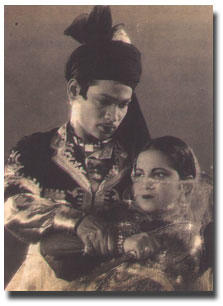
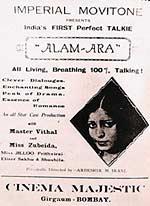
in india, the first talkie 'alam ara' was based on a persian tale, suitably indianised by a veteran parsi theatre-wallah and directed by a parsi, ardeshir irani. the producer, the director, the cast, the crew, the trade, the cinemas, the critics and the audiences- none of them was ready for it. working with the most rudimentary kind of knowledge of sound and its processing, with equally unprepared actors, ardeshir irani had embarked on an adventure as spectacular as the subject of the film he was making. in an era when the producer, director and the lead actor(quite often, one idealist performed all the three functions!) took the prints and the projecting equipment and the crew providing the live musical support and the promotional material, on bullock carts to the audiences in villages and towns, it, probably, didn't seem such a foolhardy enterprise to him. because there were others,equally obsessed, who were undertaking similar ventures in bombay itself, in calcutta, in nasik, in kolhapur, in vizagapatnam, in madras, in mysore and in lahore. looking back, one might conclude that it was sheer good fortune that 'alam ara' hit the screen first. because it was followed by a series of talkies in several indian languages the very same year(1931). and this was just three years after 'the jazz singer', the first hollywood talkie. can we produce that kind of a competitive performance now? in any field? that was the spirit of the era.

what fuelled that widespread drive to pioneer? or, to be more exact, to be the first? ask microsoft. it is the power that every new watershed technology promises the earliest convert. the power to colonise the largest territory, negotiate the best of terms with the trade, capture the widest market, preempt the toughest competition. the power to dominate.

and the pioneers had readymade content, in the form of the vast repository of indian mythology, folklore and legend and literature. it was a time when everyone, whether in the field of cinema or literature or politics or industry, seemed undaunted by the challenges that a hopelessly underdeveloped india posed- they were ready to make the best use of whatever resources they had. and for the cinema folks, the mother lode of indian lore provided the richest source of quality material.

so the swashbucklers and other movies of the 'folk' genre they made had a defined context, a certain recognizable source and an identifiable time-age frame. do the later movies, made after independence, reveal a growing tendency to deny heritage, roots and ideals? specially, the telugu folk movies made in the sixties appear to do so. their indifference to time- isn't that a sure sign of regression? of a people slowly going back to a time of fantasy - when millennia were callously bunched together as vaguely classified 'yugs'? isn't that a sign of denial of the immediate past, specially the eventful battles waged for freedom? of history and of aspirations of redemption and development?

take the taj mahal out of agra and it ceases to tell a story. the filmmakers of the sixties, it would seem, were breaking one of the cardinal rules of storytelling: one that no grandmother ever forgets. to begin every story with a reference to time...long, long ago.

this violation was indicative of the denial of not just the past but, more importantly, the present ( the time the films were made). it was a pointer towards the growing disillusionment in the country, the disappointment with the state and its performance, the slow descent into pessimism & resignation. the lost wars, the famines, the shortages and the queues, the growing corruption and joblessness were taking their toll. india had changed three prime ministers- but the people had very little say in this regard. were they slowly realizing that they were not in charge- just as they weren't all through history?

young india was growing too old, too early.

01/08/05

an odyssey


an odyssey
is a journey
that begins in a hurry
and ends as a story
told and retold
printed and sold
praised and admired
filmed and criticized
as all the while
you grow old
your teeth gold
and your sons pray
that you start
on another odyssey
and this time,
stay away.
sounds neat, right? javed akhtar does too. just as all cleverly packaged nonsense does.

the swashbucklers !

(swordplay part 3) douglas fairbanks sr., 'the king of hollywood', was the first real star of this genre- call it costume epics, adventure movies, period dramas or as in telugu cinema- folk movies. from 1916 till the end of the 1920s, his meticulously crafted image of the dashing, sword-wielding do-gooder held american and other audiences' unstinted attention. a few years into the thirties and his name steadily slipped off the marquee. when he rose, his climb was swift, and when he fell, no one really missed him. you could find a few parallels in indian cinema too: particularly in the careers of stars of this genre.
in the thirties, errol flynn became the reigning sabre-rattler. douglas fairbanks jr. too tried his hand- but tasted little success. but the genre hung on and never really died. it changed, shifted shapes and wormed its way into various other forms.
'Adventure Films are exciting stories, with new experiences or exotic locales. Adventure films are very similar to the action film genre, in that they are designed to provide an action-filled, energetic experience for the film viewer. Rather than the predominant emphasis on violence and fighting that is found in action films, however, the viewer of adventure films can live vicariously through the travels, conquests, explorations, creation of empires, struggles and situations that confront the main characters, actual historical figures or protagonists.' this from a pundit.
i'll pick on the last line- ' actual historical figures or protagonists'. folk movies in telugu never attempted to situate their plots in any particular age or period of history. as i said earlier, the time element never really bothered the makers- delivering vicarious pleasure to the audiences did. this is the point where hollywood and desi cinema part company and go their separate ways. most hollywood period adventures were set in some actual periods or based on works of fiction of authors of those periods. in telugu, the film that comes closest to being classified as a period drama set in a particular age was 'malleswari' and it can hardly be called an adventure flick. 'ekaveera' was based on a work of fiction set in a particular age, but that was the rare exception. the earliest telugu folk movies drew their themes from folk tales which had been passed down through generations and generally revolved around metamorphosing legends loosely connected with various village deities. the later films mimicked the format but generally evolved their own content. and the content, in my view, reflected the time they were made in more than the time they were supposedly set in.
(the picture shows c.h.narayan rao, one of the earliest telugu stars.)

30/07/05

on and on


does a tv drone
on and on,
lying in wait
for a catastrophe to happen,
and then wail
on and on?

an everyday zalzala


roz ba.Dhataa huu.N jahaa.N se aage/
phir vahii.n lauT ke aa jaataa huu.N /
baarahaa to.D chukaa huu.N jin ko/
i.nhii.n diivaaro.n se Takaraataa huu.N/
roz basate hai.n ka_ii shahar naye/
roz dharatii me.n samaa jaate hai.n /
zal-zalo.n me.n thii zaraa sii girah/
vo bhii ab roz hii aa jaate hai.n
my crude translation of the kaifi azmi poem above::
i venture out, everyday, ahead of the world
and find myself at the same place everyday
the walls which i had brought down
i bump into them, everyday.
many cities spring up everyday
and sink into the ground
the tremors faltered a little
but they return everyday now.
i'm thinking of the mumbai slums - will they return too after the havoc of the very recent past?

28/07/05

aara huun main

raad huu.N barq huu.N bechain huu.N paaraa huu.N mai.n
Khud-parastaar, Khud-aagaah, Khud-aaraa huu.N mai.n
gardan-e-zulm kaTe jis se vo aaraa huu.N mai.n
Khirman-e-jaur jalaade vah sharaaraa huu.N mai.n

here's my vain translation:
i'm thunder, i'm lightning, i'm the poison that kills
i know, i act, i stand up
i'm the saw that'd severe the oppressor's neck
i'm the spark that'd set his world on fire!
that was a poem by maqdoom mohiuddin. i can't set the world on fire but, perhaps, somebody out there can.
the picture shows the falaknuma palace: an oppressor's lair once.

27/07/05

cut and thrust.

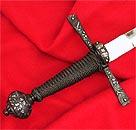
(swordplay part 2) the rapier is a slender double-edged sword that can be used to both cut and thrust. it is often accompanied by its sidekick, the dagger. just as our rapier-wielding hero is often accompanied by the character providing the comic relief in the movie. the sidekick is a vital tool- measured against his clumsiness the hero would always look more efficient. his rough, rustic simplicity makes the hero look suave and polished. his ungainly physique makes the hero look strong and athletic.
this is a cinematic ploy, employed even today, to bolster the hero's persona. except, the hero has more than one sidekick now. these additional props are, perhaps, a sign of the times. of our growing incapacity to believe in heroes. and conversely, they also reflect on the inadequacy of the lead actors entering, or being thrust upon, the world of telugu cinema today. one can derive some minor consolation from the fact that tamil flicks , and telugu movies based on them, often use dozens of such props. consider, for instance, the horde of sideys crowding most of the scenes in basha.
coming back to the sidekick in the 'folk' movies: he also performs another crucial function in the movie. his unflinching loyalty and support make all the hero's exploits seem, somehow, right and justifiable. the hero's irresponsible philandering, his overreaching ambition, his unstated aversion to a normal vocation and his problems with authority are all pushed into the background by the sidekick's presence. in a way it's the sidekick who makes the hero!
let's consider the sidekick's personality: as characterization has never been one of telugu cinema's strong points, we have to build the character ourselves from whatever rudimentary details we can glean from the movie itself. let's look at his home and family- it is often left very vague and undefined. he's a hanger-on, his station in life is to hang around the hero and his home, why does the director need to dwell on his home and hearth? his roots, his growing years and the experiences that moulded him are all unimportant. in contrast, though placed in a workingman's family, the audience is never left in any doubt about the hero's noble antecedents. and his eventful infancy and childhood. and his family, stepmothers and brothers. and his guru... and other details of his life and and times.
what does this mean?
it means the filmmaker knows his pecking order. the hero's armed rebellion is not for any radical redistribution of power but to effect a transfer of authority from a reigning tyrant to a potential tyrant. the sidekick's role, as a member of the great unwashed, was to lend legitimacy to the hero's claim and not to put forth his own point of view. just as indian voters are expected to endorse one clan's claims over another and not to stake their own claim. therefore, the sidekick's roots are irrelevant, just as the roots of a majority of indian voters. is that also the reason why the 'period' any 'folk' movie is set in, always remains unstated? because the director is making a film on his own times? the sidekick is a mere rubber stamp. a cheering supporter (just as any indian voter) and not a partner. his stake in the fruits of the campaign the hero leads is nonexistent. revolution is a tea party, according to the director, but that does not mean everyone drinks from the same cups as you!
ten years after independence, that was the director's view on indian democracy.
i'll take a break here. before that, let me try to answer the question: why does the hero prefer the rapier? is it because he needs to flaunt it, frequently, in front of the heroine and her other suitors, to reinforce his claim? with its seeming suppleness and easy swing, the rapier is , perhaps, the best weapon to publicize his virility.
on the sidekick and other tools, later.

25/07/05

on swordplay !!!


picture this: a young man, slightly fat, always dressed in tights. he's a commoner, but largehearted and a skilled swordsman. a happy-go-lucky fellow whose favorite pastime is playing the fool with his friends and standing up for the villagers' rights. it is this latter avocation of his that pits him against the king's cruel brother-in-law and his men. he confronts and chases them away with his deft swordsmanship (swordplay is perhaps a more appropriate term). from here on chasing them away becomes one more of his favorite pastimes. scaling up the palace walls to woo the princess, becomes another. he has bumped into her during one of his numerous adventures and decided she's it. planning an insurrection with the dhoti-clad peasantry in a cave-like hideout, befriending wizards and holy men, outwitting the evil tantrik, uniting his estranged parents etc., are some of the feats he accomplishes before winning the crown and the princess.... play around with any permutation or combination of the above elements and what you'd come up with is a 'folk movie' or what can be better described as a fictional, period drama. except, the period any movie 'x' of this genre purportedly refers to is never properly defined, in the tradition of all folk lore, and the drama part of the
movie is always hopelessly melodramatic.
movies of that genre of telugu cinema has few takers now, the pundits say. adventure, romance and rebellion- out of fashion?
now, a confession: i like those movies. and the more i see of today's fare the more i like those old flicks. their approach to storytelling was breathtakingly simple. and so were the stories, or, should i say story? the devil, like always, lies in the details. for instance, why does the hero wield the french rapier most often when he could have chosen from a wide variety of indian swords? more questions in the next post...

a fool and his ministry...


how do you come to terms with a situation wherein someone you trust your future bread, butter and cable tv with
goes and deposits the same trust in a speculating cheat? the least you expect of a minister is that he should have a little more sense than a semi-literate housewife who would perhaps, in understandable circumstances, be tempted to part with her prized jewellery in the expectation of doubling it, to a charlatan masquerading as a tantrik. those minor incidents of deception evoke, among other emotions, a feeling of sympathy for the victim. should we sympathise with a public official who gave away the equivalent of, roughly, the average yearly earnings of around 5500 indian families?
what's being paid, not returned , is damages. by a company which has a long history of covering up, burying, or simply refusing to acknowledge the questionable actions of authorities at the very top of its echelons. a sizeable portion of volkswagen's dark record of slave labour in nazi germany has not been disclosed until now. so the company, a pastmaster at this game, is moving quickly to sort out the misdeeds of a mere representative to pre-empt the minor embarassment of legal proceedings in india, in order that it can concentrate on defusing the major embarassment caused by much bigger fry at home.
the minister has the sympathies of his boss. after the initial euphoria over the news of damages being paid, the minister would perhaps sit down and calculate how much he has lost: i'm not implying any kind of brokerage. only the investment in acreage that seemed a sure thing until yesterday. boy, does he need sympathy!
a fool and his money are easily parted, they say. a fool and his ministry? well, the minister can check in next door.. and wait for the next schustler-hustler to come around on an even more alluring special purpose vehicle to take him for a rollicking new ride.
an afterthought: shouldn't it be our government which decides the extent of damages it has suffered?

24/07/05

the manmohini act


finally, we have a shadow prime minister. or more correctly, a prime minister who prefers to be a shadow. or is that a shadow as a prime minister? we hear from the left, and from the right..but the prime minister? if he does speak, he does it into his beard or to the congress. no, i don't mean his party- they'd rather hear from the person in the shadows, behind the shadow. a gap, as large as the country, exists between him and the country. he doesn't have the messianic persona of nehru, indira's catchwords and schemes... he doesn't even have a complacent snore like deve gowda's.. how's the hoi polloi supposed to pick him out from behind the dark veil of shadows and get to know him? to know what he plans to do about them? they might not be as smart as the people they voted for, or the people who voted in their name, but they are the ones who picked the shadows who picked him to do this manmohini act to strike the objecting middle classes dumb. until now, he's done precious little to impress either the fawning middle classes or the meddling classes representing the left. every member of the supporting cast pontificates on policy except for the prime minister..and we hear sickeningly familiar rhetoric about strengthening the public sector. in my view, every step in this direction would punch one more hole in the sinking ship that's rural india where these precious resources should rightfully, and at least now in the face of mass suicides, go. isn't that another major plank of yours pm, reviving the rural economy?
to end, he doesn't seem to be a prime minister who is fully engaged- definitely not enough for a person touted to be a formidable egghead. there are more than four million young people out on the streets and fields and other work and loafing places of andhra pradesh alone, when they are supposed to be in school, and the fact that twenty or thirty years from now these citizens would be just as hazardous a material to use or dispose of as the plutonium the pm has gone looking for in america should give wannabe-superpower india some food for thought.
 
Add to Technorati Favorites