i had commented thusly on a well-written (as always) post by dilip d'souza a few months ago. the post was on the employment guarantee act and dilip's dissatisfaction with it being turned into an assurance instead of a guarantee. (dilip did not respond to it.. i don't know if he read it. i'd like to republish it here in the hope that it might elicit some response. i'd like to add some more thoughts to this in a later post).
here goes :
''Thus the scheme to "assure" wage-employment to poor rural families "assures" instead of "guarantees" so that the scheme will not be legally binding.' (dilip's words).
the govt.,(the centre and the states) spends around two-and-a-half hundred thousand crores every year with the aim of helping the poor. this it does through various subsidies, grants and other means.now, you tell me, how is the government supposed to 'guarantee' the spending of any amount beyond this huge sum already committed? the sum committed already constitutes a major portion of its yearly budgetary spending - how is it supposed to raise(something in the range of 10,000-60,000 crores) and spend(and more effectively than the earlier schemes you have referred to ) a sum beyond its current capacity ? under the circumstances, don't you think the pm did the honorable thing by 'assuring' and not guaranteeing work? a guarantee would have been a false promise. the proponents of this current project are the same ideologically inclined wise men who had earlier backed the failed schemes you mentioned. they have always remained closest to the ears of the powers-that-be and (avowedly) to the pulse of the poor. it's funny that they should raise the questions we should be asking. right to work shall be supported by the right to information act? what about the right to education, guaranteed much earlier? a character in the movie 'austin powers' points out why james bond survives all the attempts on his life : because the villains were too smart for their own good. they would think up elaborate schemes to torture and kill him where a simple bullet to the head would have served much better. why do we fall prey to the temptations of these smart, elaborate schemes when a simple straightforward dole would cost half as much and be doubly as effective? it would avoid the pitfalls of going through the sieves and filters of the babus, elected officials, contractors and others who block the path between the poor and the promised manna. it would also eliminate the necessity of a hundred such schemes and considerably lessen the strain on governmental resources and more importantly, attention. mahbubnagar, one of the poorest districts in india, sends every year (as reported by mr.p.sainath in the course one of his expeditions in search of the holy drought) tens of thousands of migrant construction workers to mumbai and the school drop-out rate in the district too increases every year. you would find a similar picture in all the backward districts of india. the schizophrenia, i believe, lies not in the attitude of the middle classes who live only a few notches better than the slumdwellers (at times) but in the attitude of those who hide behind the poor. why do they pay so little attention to the non-voting children in mahbubnagar as compared with the voters in mumbai? a simple dole of ,say, rupees five hundred a month (which is what, almost, the current bill assures) to rural parents who send their children to school would not only cost much less than what the current project would but also a. stop the migration and b. protect the rights of the children.would you call that charity? most of the subsidies and other giveaways intended for the poor are today cornered by the more privileged classes. why shouldn't the poor have their share? but that would not be elaborate enough for the wise men. have you considered why the pm had said so little on the bill he is supposed to pilot than its votaries in the political class and the press? because it ties him up in the ultimate fiscal knot which would severely restrict any maneuvring space he would need to formulate any ideas of his own on tackling poverty or any other major issue (like how to reduce the burden of the 'elaborate' schemes so that the poor get more attention not the poverty-mongers). the wise men have effectively made irrelevant the very virtue/merit on which he was chosen: his ideas. let's not support this farcical exercise of creating 'work' for the poor when the government can't find work for its own babus. or, if we should, let's rename it : right to profits-for-all-except-the poor.'


24/03/06
sonia & the 44 profiteers
sonia loves to sacrifice-
there's no profit in office
when the opposition's upto nothing nice
and the reds listen to no pleas.
this politics is a dirty game
but she has learnt the abc:
pull the rug from under them
then everything comes to you, nice and easy.
look at the mice scurry for the gaddi
she doesn't need it, no please!
she married into the family gandhi
in india, is there a bigger office?
when you live in 10, janpath,
you know power isn't an easy path-
only when 44 others pay the price
do you get to claim the sacrifice!
there's no profit in office
when the opposition's upto nothing nice
and the reds listen to no pleas.
this politics is a dirty game
but she has learnt the abc:
pull the rug from under them
then everything comes to you, nice and easy.
look at the mice scurry for the gaddi
she doesn't need it, no please!
she married into the family gandhi
in india, is there a bigger office?
when you live in 10, janpath,
you know power isn't an easy path-
only when 44 others pay the price
do you get to claim the sacrifice!
12/02/06
congress party, my pooch
when i die, i want to come back as the congress party.
i'll be a blob, a forming, re-forming thing..a perpetual changing object, a now amorphous, now defined mass of flubber with one unchangeable feature which would be my tail. my tail would define me, be my compass, my head and my vishnu and my brihaspati and my meru and my indra and my iravata and my samaveda and my ganga and my skanda and my ashwatha and my narada and my bhrigu and my kapila and my maritchi and my uchchaisravas and my vajra and my kamadhenu and my vasuki and my varuna and my yama and my prahlada and my garud and my gayatri and my mrigasira and my vasanta and my first, and last and my middle..
the rest of me shall live, work, strain to please my tail... my gandhi.
i'm sorry... the first line should read ' when i die, i want to come back as the congress party's tail'.
i'll be a blob, a forming, re-forming thing..a perpetual changing object, a now amorphous, now defined mass of flubber with one unchangeable feature which would be my tail. my tail would define me, be my compass, my head and my vishnu and my brihaspati and my meru and my indra and my iravata and my samaveda and my ganga and my skanda and my ashwatha and my narada and my bhrigu and my kapila and my maritchi and my uchchaisravas and my vajra and my kamadhenu and my vasuki and my varuna and my yama and my prahlada and my garud and my gayatri and my mrigasira and my vasanta and my first, and last and my middle..
the rest of me shall live, work, strain to please my tail... my gandhi.
i'm sorry... the first line should read ' when i die, i want to come back as the congress party's tail'.
22/01/06
have no bread ? eat ega.
a conversation between a babu and a citizen :
citizen: ega ? i still don't understand what it means .
babu: ( a little sarcastic) you needn't, because it would be cooked and delivered to your doorstep as egp.
c. what's an egp, does it contain eggs?
b. no, but it may contain grain as a nutrition supplement.
c. may contain ?
b. it depends, you see, on the availability of funds and stocks. and work.
c. work ?
b. yes, you have to pay in work for whatever you get in return.
c. work ?
b. like filling up trenches.
c. oh ?
b. and digging up trenches. or whatever you in the boondocks consider 'productive assets'.
c. so it's a dole?
b. definitely not. we tax the rich and pay for this programme.
c. (now really interested) you mean you tax the rich and pay us?
b. no, we tax the rich and make you work.
c. that means we would get all that you take away from the rich?
b. no, you might get the minimum wage.
c. who gets the rest?
b. what do you mean?
c. i mean who gets the rest of the money from the taxes after you pay me?
b. the pm says 'institutional mechanisms' would be set up to deal with that.
c. (disgusted) deal with whoever steals the money ?
b. no, to see that there is a 'timely transfer of resources' ?
c. who gets transferred ?
b. whoever fails to show 'transparency in maintenance of muster rolls and payment of wages.' ?
c. what ?
b.whoever says you worked for 30 days when you only worked for 3.
c. who ?
b. your programme officer.
c. why should he say that i've worked for 30 days when i've not worked for a day ?
b. because he's not transparent - he should tell you everything about the scheme the day you register.
c.( feeling he's the one that's transparent) nobody tells me anything.
b. don't worry. now everything has to be put down on paper and recorded. you'll also get a job card....don't pawn that.
c. and then?
b. you apply for work.
c. i can't write.
b. that's okay, the panchayat will help you.
c. what's in it for them ?
b. 50%.
c. you mean they take away half of what i get paid ?
b. no, you idiot. they get half of all funds for the scheme.
c. who gets the other half ?
b. the programme officer decides that.
c. i work for nothing ?
b.you get paid for whatever work you do.
c. (scratching his head, making rapid calculations on his palm) the officer gets 50% and the panchayat gets another fifty..please sir, what do i get?
b. (exhausted) you get paid for 100 days of work.
c. what work ?
b. (#$%..!) whatever work the panchayat assigns you.
c. (thinking of his past experiences) what if they don't ?
b. you get paid anyway.. at least a part of the minimum wage for not being given work after applying.
c. ( warming up to this idea) what if i gave you a part of that.. you know..so that i
keep getting whatever money..
b. (frowning) yes.
c. ...without being assigned any work..
b. (feigning anger) that's illegal.
c. (grumbling) i won't get any work because the sarpanch doesn't like me. i voted for the opposition..
b. you can complain.
c. what would happen then ?
b. the programme would be stopped in the whole district.
c. ( wondering how that would help ) who thought up this scheme..a sardar ?
b. oh, it has its supporters... a belgian who likes yatras.. an italian who doesn't... a bengali who didn't like the ias... ....
c. (lost in thought) i can ask sagar anna for help.
b. who is he?
c. he heads the racha (..konda dalam, he almost says, but stops )... maybe i can give him something..
b. who ?
c. the sarpanch.
b. i told you the whole programme would be stopped if there are any reports of corruption.
c. so how do i get any work?
b. you apply for it, you are assigned work and then you get paid for it.. every week ..or after two..weeks..maybe. you know how it is..
c. what if i don't get paid ? (now getting wiser) don't tell me ... i shouldn't complain..
b. i didn't say that..you could tell the gram sabha.
c. that's what i did when he siphoned off money from the housing scheme to build another floor on his house.
b. and ?
c. he hates my guts now.
b. so why don't you talk to the other leader then..the one you voted for..
c. no one listens to him now..they found fwp rice in his cowshed...
b. don't worry, they can't stop the payment..i'll be there.
c. what's in it for you ?
b. 50%.
the citizen walks away, thinking of sagar anna.
citizen: ega ? i still don't understand what it means .
babu: ( a little sarcastic) you needn't, because it would be cooked and delivered to your doorstep as egp.
c. what's an egp, does it contain eggs?
b. no, but it may contain grain as a nutrition supplement.
c. may contain ?
b. it depends, you see, on the availability of funds and stocks. and work.
c. work ?
b. yes, you have to pay in work for whatever you get in return.
c. work ?
b. like filling up trenches.
c. oh ?
b. and digging up trenches. or whatever you in the boondocks consider 'productive assets'.
c. so it's a dole?
b. definitely not. we tax the rich and pay for this programme.
c. (now really interested) you mean you tax the rich and pay us?
b. no, we tax the rich and make you work.
c. that means we would get all that you take away from the rich?
b. no, you might get the minimum wage.
c. who gets the rest?
b. what do you mean?
c. i mean who gets the rest of the money from the taxes after you pay me?
b. the pm says 'institutional mechanisms' would be set up to deal with that.
c. (disgusted) deal with whoever steals the money ?
b. no, to see that there is a 'timely transfer of resources' ?
c. who gets transferred ?
b. whoever fails to show 'transparency in maintenance of muster rolls and payment of wages.' ?
c. what ?
b.whoever says you worked for 30 days when you only worked for 3.
c. who ?
b. your programme officer.
c. why should he say that i've worked for 30 days when i've not worked for a day ?
b. because he's not transparent - he should tell you everything about the scheme the day you register.
c.( feeling he's the one that's transparent) nobody tells me anything.
b. don't worry. now everything has to be put down on paper and recorded. you'll also get a job card....don't pawn that.
c. and then?
b. you apply for work.
c. i can't write.
b. that's okay, the panchayat will help you.
c. what's in it for them ?
b. 50%.
c. you mean they take away half of what i get paid ?
b. no, you idiot. they get half of all funds for the scheme.
c. who gets the other half ?
b. the programme officer decides that.
c. i work for nothing ?
b.you get paid for whatever work you do.
c. (scratching his head, making rapid calculations on his palm) the officer gets 50% and the panchayat gets another fifty..please sir, what do i get?
b. (exhausted) you get paid for 100 days of work.
c. what work ?
b. (#$%..!) whatever work the panchayat assigns you.
c. (thinking of his past experiences) what if they don't ?
b. you get paid anyway.. at least a part of the minimum wage for not being given work after applying.
c. ( warming up to this idea) what if i gave you a part of that.. you know..so that i
keep getting whatever money..
b. (frowning) yes.
c. ...without being assigned any work..
b. (feigning anger) that's illegal.
c. (grumbling) i won't get any work because the sarpanch doesn't like me. i voted for the opposition..
b. you can complain.
c. what would happen then ?
b. the programme would be stopped in the whole district.
c. ( wondering how that would help ) who thought up this scheme..a sardar ?
b. oh, it has its supporters... a belgian who likes yatras.. an italian who doesn't... a bengali who didn't like the ias... ....
c. (lost in thought) i can ask sagar anna for help.
b. who is he?
c. he heads the racha (..konda dalam, he almost says, but stops )... maybe i can give him something..
b. who ?
c. the sarpanch.
b. i told you the whole programme would be stopped if there are any reports of corruption.
c. so how do i get any work?
b. you apply for it, you are assigned work and then you get paid for it.. every week ..or after two..weeks..maybe. you know how it is..
c. what if i don't get paid ? (now getting wiser) don't tell me ... i shouldn't complain..
b. i didn't say that..you could tell the gram sabha.
c. that's what i did when he siphoned off money from the housing scheme to build another floor on his house.
b. and ?
c. he hates my guts now.
b. so why don't you talk to the other leader then..the one you voted for..
c. no one listens to him now..they found fwp rice in his cowshed...
b. don't worry, they can't stop the payment..i'll be there.
c. what's in it for you ?
b. 50%.
the citizen walks away, thinking of sagar anna.
08/01/06
a vaartha.
he is a businessman with interests in textiles, cement, real estate and etc., his family is rich and owns a lot of property in and around hyderabad and gujarat, mostly acquired in the last three decades. he is also a rajya sabha mp from andhra pradesh.he manages his own group within the congress in the state. he also publishes a telugu newsdaily 'vaartha' from ten towns across the state. and a hindi newspaper called 'swatantra vaartha' from hyderabad and nizamabad.
so what made him think he had the right to demolish his government allotted bungalow in new delhi and construct a marble-and-carved teak eyesore in its place ? a two-storeyed concrete insult in an area where even the pm can't build beyond one floor?
girish kumar sanghi and his family have a reputation of being heavy-handed. they reportedly beat up even managers and editors who refuse to toe their line.and the power of a newspaper seals many lips. that's their way of getting business done. one year ago, a bus carrying workers from one of his factories was involved in an accident. the police arrived, and found out that the passengers were all poor schoolgirls who were returning from a night-shift at one of his factories. the opposition cried foul and then child labour. the labour minister said in the assembly : an inquiry had been initiated, but from the information he had, there was no evidence to support the charge that any child labour had been employed. so the television channels who had beamed the unhappy fact had performed the duplicitous act of conveying one thing to the people and another to the minister. we know that happens.
vaartha is the second most widely read telugu newspaper in a.p. that means, when push comes to shove, sanghi could be the second biggest arm-twister in the state. so i look around, and i urge you to do so too: and tell me how many sanghi parivars can you spot around the country. too many, in my opinion. so what, you ask, whatever news i consume in the morning, and sometimes in the afternoon and the evening turns into raddi by the next morning.
we know what micro-organisms that live for less than twelve hours are capable of doing.
and there is hardly anything we can do about it. like someone i know realized when he came up against sanghi. one of sanghi's companies was building a pricey apartment building in one of the poshest areas of hyderabad. there was only one small lane that connected it with the main road. my acquaintance owned a plot that lay between the proposed complex of buildings and an arterial lane, bigger and better, to the main road. the arterial road, if extended to sanghi's complex (slicing the vacant plot that lay in the middle), would definitely add to the saleability of the complex.this is what the sanghis wanted.one day, a crew of municipal workers began demolishing a part of the wall dividing the complex and the plot. the plotwallah accosted them and he was told they were only clearing the road (?) that led to the complex. so the owner, because he wasn't aware of any plans to build a road, panicked and ran to his lawyer. the family had owned the plot for more than forty years and it had collected its share of the dust of disputes over the years. but his rights were almost clear. and there never had been a road proposed through the middle of his plot. the sanghis, in their ingenuity, had thought up one and certain babus, with a little 'persuasion' had dutifully agreed. so the plotwallah deduced he had to take certain 'clever' measures to protect his property, because he could sense big shadows lurking around his plot, before any 'timely' relief arrived from the court.so he approached another minor congress leader to stop sanghi from pushing the authorities to build a second approach road to his complex 'partitioning' the plot he had foolishly saved for forty years. he had very little time - a dirt path had been cleared through his plot and the road could be laid any day- given the 'urgency of pupose' of the municipal authorities.
the minor leader liked the idea of fishing in troubled lands in such an expensive district..so he sent along a couple of 'party workers' to scare off any possible invaders by brandishing their credentials as 'ruling party yuva' leaders. the owner, still not reassured, thought up the idea of making his plot truly 'unpaveable'. so he got a young friend of the family to haul in several truckloads of boulders ( the remains of the huge rocks that dot hyderabad which are now being blasted and cleared by truckloads everyday to make way for new buildings, despite several conservationists' protests) and plonk them on his plot so that it couldn't be cleared. the deed was done, and without much cost, because the truckers who hauled the rocks were looking for empty plots to dump the rocks anyway.the rocks were big, and despite the fact that they were only pieces cut from bigger boulders some of them stood as high as a man. they can't be cleared in less than a week, he thought.
he woke up the next morning to discover that he made the vaartha that day. featured on top of the front page, just below the masthead, was the news that he had grabbed a 'sarkari' road with the help of congress party goons.. while he had been enjoying the sound sleep of a satisfied landgrabber, the presses and other gears of authority had been busy.
the news made only vaartha, and no other newspaper.
certain babus among the municipal authorities who had all along supported the sanghis' bluff now expressed righteous chagrin at their non-existent road being grabbed. and took' immediate measures' to reclaim their lost road. a spanking new road, after clearing the rocks with much motivation and machinery, made its way through the plot by, not the next week, but the next morning. increasing the value of the apartments in the proposed complex by several notches.
this happened nearly an year ago. now, to answer my own question, sanghi probanly thought (when he was applying his special building skills in lutyens' delhi) that when he could always have the right of way in hyderabad, why couldn't he enjoy the same privilege in dilli ?
he knows what to do if stopped...start another edition of 'swatantra vaartha' in delhi.
so what made him think he had the right to demolish his government allotted bungalow in new delhi and construct a marble-and-carved teak eyesore in its place ? a two-storeyed concrete insult in an area where even the pm can't build beyond one floor?
girish kumar sanghi and his family have a reputation of being heavy-handed. they reportedly beat up even managers and editors who refuse to toe their line.and the power of a newspaper seals many lips. that's their way of getting business done. one year ago, a bus carrying workers from one of his factories was involved in an accident. the police arrived, and found out that the passengers were all poor schoolgirls who were returning from a night-shift at one of his factories. the opposition cried foul and then child labour. the labour minister said in the assembly : an inquiry had been initiated, but from the information he had, there was no evidence to support the charge that any child labour had been employed. so the television channels who had beamed the unhappy fact had performed the duplicitous act of conveying one thing to the people and another to the minister. we know that happens.
vaartha is the second most widely read telugu newspaper in a.p. that means, when push comes to shove, sanghi could be the second biggest arm-twister in the state. so i look around, and i urge you to do so too: and tell me how many sanghi parivars can you spot around the country. too many, in my opinion. so what, you ask, whatever news i consume in the morning, and sometimes in the afternoon and the evening turns into raddi by the next morning.
we know what micro-organisms that live for less than twelve hours are capable of doing.
and there is hardly anything we can do about it. like someone i know realized when he came up against sanghi. one of sanghi's companies was building a pricey apartment building in one of the poshest areas of hyderabad. there was only one small lane that connected it with the main road. my acquaintance owned a plot that lay between the proposed complex of buildings and an arterial lane, bigger and better, to the main road. the arterial road, if extended to sanghi's complex (slicing the vacant plot that lay in the middle), would definitely add to the saleability of the complex.this is what the sanghis wanted.one day, a crew of municipal workers began demolishing a part of the wall dividing the complex and the plot. the plotwallah accosted them and he was told they were only clearing the road (?) that led to the complex. so the owner, because he wasn't aware of any plans to build a road, panicked and ran to his lawyer. the family had owned the plot for more than forty years and it had collected its share of the dust of disputes over the years. but his rights were almost clear. and there never had been a road proposed through the middle of his plot. the sanghis, in their ingenuity, had thought up one and certain babus, with a little 'persuasion' had dutifully agreed. so the plotwallah deduced he had to take certain 'clever' measures to protect his property, because he could sense big shadows lurking around his plot, before any 'timely' relief arrived from the court.so he approached another minor congress leader to stop sanghi from pushing the authorities to build a second approach road to his complex 'partitioning' the plot he had foolishly saved for forty years. he had very little time - a dirt path had been cleared through his plot and the road could be laid any day- given the 'urgency of pupose' of the municipal authorities.
the minor leader liked the idea of fishing in troubled lands in such an expensive district..so he sent along a couple of 'party workers' to scare off any possible invaders by brandishing their credentials as 'ruling party yuva' leaders. the owner, still not reassured, thought up the idea of making his plot truly 'unpaveable'. so he got a young friend of the family to haul in several truckloads of boulders ( the remains of the huge rocks that dot hyderabad which are now being blasted and cleared by truckloads everyday to make way for new buildings, despite several conservationists' protests) and plonk them on his plot so that it couldn't be cleared. the deed was done, and without much cost, because the truckers who hauled the rocks were looking for empty plots to dump the rocks anyway.the rocks were big, and despite the fact that they were only pieces cut from bigger boulders some of them stood as high as a man. they can't be cleared in less than a week, he thought.
he woke up the next morning to discover that he made the vaartha that day. featured on top of the front page, just below the masthead, was the news that he had grabbed a 'sarkari' road with the help of congress party goons.. while he had been enjoying the sound sleep of a satisfied landgrabber, the presses and other gears of authority had been busy.
the news made only vaartha, and no other newspaper.
certain babus among the municipal authorities who had all along supported the sanghis' bluff now expressed righteous chagrin at their non-existent road being grabbed. and took' immediate measures' to reclaim their lost road. a spanking new road, after clearing the rocks with much motivation and machinery, made its way through the plot by, not the next week, but the next morning. increasing the value of the apartments in the proposed complex by several notches.
this happened nearly an year ago. now, to answer my own question, sanghi probanly thought (when he was applying his special building skills in lutyens' delhi) that when he could always have the right of way in hyderabad, why couldn't he enjoy the same privilege in dilli ?
he knows what to do if stopped...start another edition of 'swatantra vaartha' in delhi.
09/10/05
a little fifthness.

this poem was written in telugu by a dalit poet, satish chander, around nine years ago. the poem, a response to the riots in los angeles, was his way of adding fuel to the fire of black anger in america, the poet said.
his words : 'american blacks aagraha jvaalalaku svadESee aajyamidi'.
i tried to translate it to see whether i understood it correctly, fully..the poet evokes varied images..in controlled anger. he gave the poem an english title 'lost angels'. that's the only part of the poem which remains true to its original spirit, i think.
here goes :
it's not just milk
but crores of sins are white too
only, adulterated by a few tears
glass-eyed swans
tell me about the color of tears, not the portion of water
you're the angels
who slipped off a tipsy heaven
reveling in the waters, you must have slurped the oceans
tell me about the taste of tears
in god's deep embrace
you must have perspired a little
tell me about the scent of tears
i, like the dark cloud
could rain down a flood
on how tears feel
it's not just jasmines
hand-gloves are white too
only, stained by a little blood
having washed your hands, emperors
before you crown me with thorns
show me a thimbleful of dark blood
you are the the serpent kings of the primeval jungle
you must have bitten the dust, where man got hurt
tell me about the taste of the blood that spilled
when you caressed the warrior's back as a whip
the sandalwood trees must have swooned
tell me about the scent of blood
having ascended the cross
like a throne, i, on the other hand
when asked about the blood
will guide your fingers through the holes in my palms
not just the seven colors
the four varnas mixed are white too
only, darkened by a little fifthness
raised by the crumbs of angarajya to a finer varna, o arch sudras
tell me about the color of power
from god's feet to his shoulders
you've climbed, oppressors
manu's dharma in your moneypurses
hoarded, of course,
tell me about the taste of power
in the scum-laden lake
what springs forth doesn't reflect your face
tell me about the scent of power
i, who you have never considered human
if asked about the feel of power
shall unpeel its skin, with illustration.
08/10/05
hammer and tongs ?
'Buddhadeb’s scramble for FDI in Bengal is indeed providing the Congress with its most persuasive justification for neo-liberal policies at the Centre. In a bid to deny any contradiction between CPI (M)’s protest against FDI in the Centre and its passionate embrace of FDI in Bengal, Comrade Karat and Yechury have declared that FDI in Bengal, as opposed to that proposed by the UPA, fulfils the three criteria of ‘promoting productivity, upgrading technology and generating employment’. Yet, they are at a loss to explain how 100% FDI in airports (as promised by Buddha) can promote productivity, technology and employment in Bengal , but not in Hyderabad or Delhi ! '
i found that not in indianeconomy.org but at the cpiml (liberation) site.
i found that not in indianeconomy.org but at the cpiml (liberation) site.
25/09/05
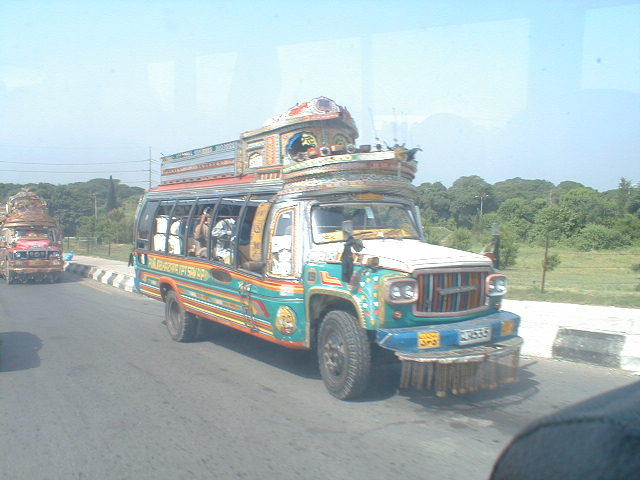
guns, drugs and above all sex.
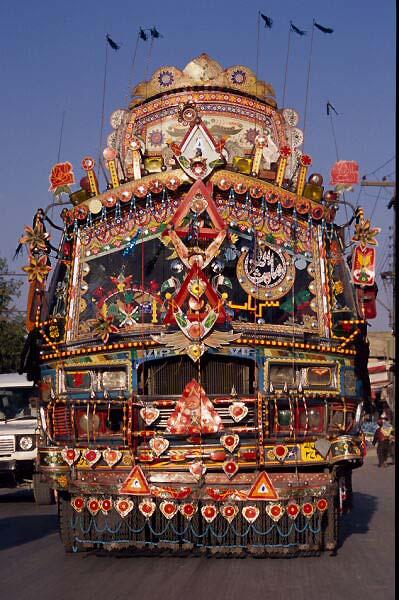
what an american finds out bothers the pakistanis more on a bus to peshawar.
the pictures : pakistani defence forum.
conductor bas ?
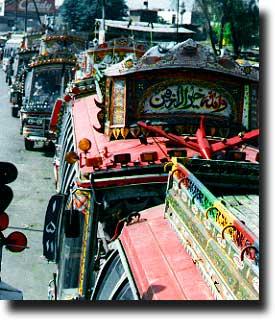
and the men retain the driver's seat.
(if the site has been updated, you have to go to the archives for the story on women conductors in pakistan).
23/09/05
parrotspeak 2 : control is good.
macroscan calls itself a network of 'professional economists seeking to provide an alternative to conservative and mainstream positions....' meaning those who disagree with their views are either a.'conservative' or worse still, b.'mainstream'.
isn't the term 'conservative' supposed to indicate a person/idea/institution who/which seeks to cling to tradition and established norms ? i don't think we should apply the term conservative, as it is understood elsewhere in the world, when we seek to categorize persons/ideas/institutions who/which seek to dismantle an excessively regulated 'command economy' - it wouldn't be accurate because those who held the 'mainstream' position that india should follow the 'socialistic' path until yesterday now 'conservatively' cling to their old trenches. i say trenches because the limited, but definite successes in certain partially deregulated sectors in the last fifteen years in india has driven these 'conservatives' into, understandably, a feeling of being under siege.
i don't think one needs to be a 'professional economist' to recognize a conservative position when you see one. you only require common sense to spot that.
what's this all about ? well, this train of thought started off yesterday when i spotted the jayati ghosh article, which i referred to in my last post, in macroscan. jayati ghosh has been a key votary of the nrega - does that make her a 'heterodox economist' (another label i found on the site) who's neither mainstream nor conservative ? the nrega falls into exactly the same category of 'noble' 'pro-poor' schemes that have been the norm in indian policy-making, as far as i can recall, since my schooldays in the indira gandhi era, and long before that. no, that doesn't make her heterodox, because she pursues a very mainstream, very conservative style of thinking. please ms.ghosh, if you ever read this, don't try to wear the mantle of an objective 'professional' offering 'alternative' ideas.
the lack of objectivity in the article i referred to is what troubles me more than the very real differences in growth between the indian and the chinese economies that she points out. though she doesn't draw any prescriptive conclusions, she definitely does point us in that direction. and what are the conclusions we must draw from her non-thesis ?
that control is good. that china's growth was entirely fuelled by internal resources wisely 'allocated' by the state. that india didn't control its banks enough. deregulation of the banks was foolish.
please read the second significant difference between the indian and chinese economies according to her :
'The control over the domestic economic in China has been most significant in terms of the financial sector, which describes the second big difference between the two economies. In India, the financial sector was typical of the ''mixed economy'' and even bank nationalisation did not lead to comprehensive government control over the financial system; in any case, financial liberalisation over the 1990s has involved a progressive deregulation and further loss of control over financial allocations by the state in India. But the financial system in China still remains heavily under the control of the state, despite recent liberalisation. Four major public sector banks handle the bulk of the transactions in the economy, and the Chinese authorities have essentially used control over the consequent financial flows to regulate the volume of credit (and therefore mange the economic cycle) as well as to direct credit to priority sectors. Off-budget official finance (called ''fund-raising'' by firms) has accounted for more than half of capital formation in China even in recent years, and that together with direct budgetary appropriations have determined nearly two thirds of the level of aggregate investment. This means that there has been less need for more conventional fiscal and monetary policies, although the Chinese economy is now in the process of transition to the more standard pattern.'
i have some questions : how much of the financial 'system' in india was controlled by private banks before deregulation ? was there any room left for private players after nationalisation ?
if it's control that helped china grow faster, why is it now ' in the process of transition to the more standard pattern' ?
let's listen to what an investment analyst says:
Rahul Saraogi of Atyant Capital - 'One out of two loans in China is probably bad. India, on the other hand, has net NPLs [non-performing loans] in its banking system of 3.5%. China's bad loan problem is a legacy of its state-directed lending practices. Interest rates are completely controlled by the PboC, and the big four banks that control over 95% of banking assets have no credit scoring or credit risk based pricing mechanisms in place. It's unbelievable.
China's asset markets are very similar to the Japanese. They are very heavily leveraged and are primarily fueled by property speculation. The Chinese property market coupled with its leveraged and insolvent banking system is a very big accident waiting to happen. India has no such issues.'
if you are interested in the full interview, read it here. and read this businessweek article on the chinese banks here. and here. and more.
ms.ghosh feels the chinese wisely regulated the flow of credit. that's the crux of her argument explaining the third 'significant' difference between india and china. or was it, as saraogi says, mal-invested ?
parrotspeak 1: licensing stimulates demand.

jayati ghosh in macroscan delineating the first of ten 'significant differences' between the chinese and indian economies:'The first relates to the nature of the economy itself, the institutional conditions within which policies are formulated and implemented. India could be described until recently as a traditional ''mixed economy'' with a large private sector, so it was and remains a capitalist market economy with the associated tendency to involuntary unemployment. So the need for macroeconomic policies to stimulate demand, as common in capitalist economies, operated in addition to the usual ''developmental'' role of the state'.
a question : is a licence-permit regime a 'macroeconomic policy' to stimulate demand ? are rationing and quotas demand-stimulating mechanisms ? agricultural output constituted half of the indian gdp - was that the 'large private sector' ?
policy thrust area 19.8
'19.8 Closely monitor the tackling of Naxalism / Left Wing Extremism with a view to improving the situation over the next six months.'
that's a 'thrust area' for 'policy implementation', based on 'the commitments made in the ncmp', identified by the pmo, for the ministry of home affairs for the year 2005.
actually, there is no mention of 'naxalism/leftwing extremism' in the ncmp. the pm's office considers it a home affair - something to be settled in every policeman's home in thirteen states perhaps ? if you heard somebody call it a 'socio-economic issue' during the 2004 elections, you heard wrong.
09/09/05
cherabanda raju
he died a few years ago. many, including his associate varavara rao, suspect it wasn't a brain tumour that killed him. perhaps it was too muted an exit for a firebreathing revolutionary? ideally, he should have been killed encountering a surprised police party. surreptitiously leaving a secret conclave deep in the jungle, picking his way through dirt tracks made fresh by every passing tyrant, skirting shrines guarded by the untiring hag yellamma and skipping over heaps of sleepless ants raiding mounds of sugar left at this peer's grave or that. he should have paused and scratched himself, weary from the relentless probing of the thumma shrubs, tugged at his trouser buttons and then stopped. he should have stepped aside a little, thinking the other dalams couldn't possibly have been at this spot just half a century ago : the scorpions have this thing for warm rebellious blood. and then picking up a rapid pace, for he should have neared the village by now, he should have quickly looked around, crossed the little dirt road, and stepped down into the fields. that's when his arrival should have been noticed. he should have started trying to regain his pace on the raised, narrow path between the beds, slipped and fallen. the sharp edges of the cut, dried stalks should have made him feel a little disoriented, and then a little foolish. he should have understood then someone else had been there before him. he should have looked up and gaped right into the big dark-blue eye of the sky, speckled with bold white dots, staring back, unblinking. embarassed, he should have lowered his eyes and then slowly raised them : to the furrowed maktha bavi where the razakars had tossed in the communists, to the pit, marked by the tamarind tree, where the communists had buried the razakars...and onward to the barha darwaza of the garhi, to its top, to the giant hook where the severed head of the butcher malli mian had been hung, as a kind of trophy, and still upward to the terrace above the darwaza where the naqqara drums had stopped keeping time, fifty years ago. and then his eyes should have followed the huge walls of the garhi, the ramparts, the saw-teethed battlements... and thought about what decayed, but refused to die inside. the sheesh mahal, its walls still as smooth as the eggs that were used in its plastering, the glass-paned windows still reflecting the blues and greens of europe. and the scented fountains and the baths and the deodi and the orchards and other transplanted splendors. and the chiselled ugly rock, on a raised platform abutting a bastion, where the intransigent would be decapitated. the cherabanda.
and then he should have thought about the village outside the walls, which had been razed once, twice, thrice by the razakars as they went mad and invaded their absent neighbours... and then one errant neighbour had gone mad and refused to run away...perched atop the roof of his home, his infant son clinging to his side, he had maintained a night-long vigil with his unwieldy gun and his shouts and .....the madness had then spread..and more neighbours had come back, and the dalams..and everything had been fine for a while..the garhi had been looted..the desmukh had been chased away..the razakars lynched..and everyone was having a one fine revolution..and it had to end. the red flags had withered in the fields because the dalams went back to the hills and then the real battle began..
he should have then turned his gaze away from the village and made up his mind. he should have turned towards the hills and the river, and started walking towards them. it should have been the season when everyone is deluded into wealth..white, blue, yellow, red flowers bloom and even the grasses raise their spines tall and sprout pinkish white, mock flowers- ready to be offered to bathukamma. he should have carried the wild, living scents to the hills where the policemen waited. poet that he was, he couldn't have resisted the temptation.
then he should have been 'shot, after having refused to surrender ' . his long-dead, bearded accomplices, strewn around him, should have backed up the report.
and the river, the only witness, should have just chugged along...like it did when pothana refused to yield to the king, like a passer-by at a traffic 'mishap'. or should it have been the other river from the north-west, flowing much further south, where nagarjuna had built a university for the word ?
Song of Justice
-Cherabanda Raju
We battered the mountains
and crushed the rocks
With our muscle stones
built barrages
But who got the riches
and whose was the labour?
We cleared the stones
and tilled the wastelands
With our sweat streams
watered the crops
But who got the food
and whose was the seed?
We built our looms
and spun each thread
With our nerve yarns
wove many a cloth
But who donned it in fashion
and whose was the effort?
We worked the machines
and produced plentiful
With our blood current
ran the factories
But who built the mansion
and who lived in the hut?
Knowing the reason
we’ve taken to arms
We’ll rise up as one
for an unceasing fight
Victory will be ours
and death yours.
Translated from Telugu by Dr. V. Rama Murthy.
and then he should have thought about the village outside the walls, which had been razed once, twice, thrice by the razakars as they went mad and invaded their absent neighbours... and then one errant neighbour had gone mad and refused to run away...perched atop the roof of his home, his infant son clinging to his side, he had maintained a night-long vigil with his unwieldy gun and his shouts and .....the madness had then spread..and more neighbours had come back, and the dalams..and everything had been fine for a while..the garhi had been looted..the desmukh had been chased away..the razakars lynched..and everyone was having a one fine revolution..and it had to end. the red flags had withered in the fields because the dalams went back to the hills and then the real battle began..
he should have then turned his gaze away from the village and made up his mind. he should have turned towards the hills and the river, and started walking towards them. it should have been the season when everyone is deluded into wealth..white, blue, yellow, red flowers bloom and even the grasses raise their spines tall and sprout pinkish white, mock flowers- ready to be offered to bathukamma. he should have carried the wild, living scents to the hills where the policemen waited. poet that he was, he couldn't have resisted the temptation.
then he should have been 'shot, after having refused to surrender ' . his long-dead, bearded accomplices, strewn around him, should have backed up the report.
and the river, the only witness, should have just chugged along...like it did when pothana refused to yield to the king, like a passer-by at a traffic 'mishap'. or should it have been the other river from the north-west, flowing much further south, where nagarjuna had built a university for the word ?
Song of Justice
-Cherabanda Raju
We battered the mountains
and crushed the rocks
With our muscle stones
built barrages
But who got the riches
and whose was the labour?
We cleared the stones
and tilled the wastelands
With our sweat streams
watered the crops
But who got the food
and whose was the seed?
We built our looms
and spun each thread
With our nerve yarns
wove many a cloth
But who donned it in fashion
and whose was the effort?
We worked the machines
and produced plentiful
With our blood current
ran the factories
But who built the mansion
and who lived in the hut?
Knowing the reason
we’ve taken to arms
We’ll rise up as one
for an unceasing fight
Victory will be ours
and death yours.
Translated from Telugu by Dr. V. Rama Murthy.
15/08/05
har-fan-maula

government is the landlord with the largest surplus landholding. goverment is the tycoon who owns ships, planes, buses, trains, trucks and cars. government is the businessman who runs factories, mills, mines, quarries and souvenir stores. government is the investor with interests in healthcare, hospitality, travel & leisure, financial services, energy, food processing, warehousing, insurance, armaments, telecom, construction and housing, infrastructure and information technology.
would you like to do business with him ? (who wouldn't, right ?)
you can meet him at any of his offices all over the country. he is the the man with the unctuous smile and the outstretched hand. if he's not in, you might run into him at any street corner, dressed in a uniform, waving a lathi or a gun or, once again, an outstretched hand. or if you're lucky he might call on you at your home or your workplace. that'd be the hectoring stranger with a lathi or a gun or an outstretched hand. he might be waving a bill, a notice, a warrant, an order or none of the aforementioned.
you should start worrying when it's none of the aforementioned.
you'd be well advised to meet him on his own ground. say, on the piece of his land that you've occupied. he is a tough negotiator: if you don't like any of his rules, break them in his full view so that he'd respect you more. he doesn't like dishonesty and crookedness. if you plan to steal from him, tell him beforehand so that he'd know when to look the other way. he is obsessed with quality. if you build a bridge for him, and it's washed away, say, after five years, he'd expect you to build another of the same quality. he likes risktakers- if you succeed in duping him to the tune of a major fortune, he'd provide you with top class security at his own cost. the courts are his favorite playground. he'd like all his vendors to play a game or two of 'dispute' with him every once in a while.
those who refuse to play ball encounter more than a little misfortune.
he knows everyone. you'd encounter his name, and his various aliases, listed in the books, diaries and other records of a wide range of professionals - pimps, power brokers, smugglers, gunrunners, hawala operators, counterfeiters and others. you'll never find their names in his good books, because he is not a name-dropper. but he is their loyal friend - any offer they make him, he accepts.
if you'd like to know more about him, call on him tomorrow...
today is his 58th birthday and if you don't wish to encounter any stray bullet or bomb, stay away from the celebrations
12/08/05
the leftovers
the left holds poverty in a vice-like grip. it has long let go of the poor, but it won't release poverty from its stranglehold. it's a magnificient obsession : this fascination with an idea that, paradoxically, it wishes to exterminate. it sits quite comfortably with other diametrically opposite ideas in the left's collective consciousness. ideas like a social security net for india's babus who probably lead a more protected existence than the gold in fort knox. like protecting the public sector, whose employees collectively have more sons and daughters living abroad than any other privileged class of people in india, from foreign predators.
for a class which vehemently opposed the acceptance of product patents by the indian government, the left doesn't think twice about smiting anyone who so much as toys with the idea of cashing in politically on the product that is poverty. the left wouldn't share with anyone even the patent on their unique theory on the process of poverty alleviation ( nobody else understands the dialectics, you see).
for the left it is essential that poverty thrive in order that it be heroically challenged and killed. in other words, poverty should be protected from those others who harbour any suspicious designs on its existence or nurse any ambitions of eliminating it through any means other than the ones the left endorses.
the fig leaf of poverty, which covers nothing but itself, is the raison d'etre of what's left over of the left in india. the self-righteousness, the self-proclaimed selflessness, the theatrical austerity, the never-slipping mask of seriousness which has become an armour to protect them from being thought of as less than serious,....these are the qualities one would normally associate with the indian left......no wonder, the poor take them very seriously, and look elsewhere for answers.
like the party that stands for the rights of x left-handed caste, for instance. or to other parties that at least acknowledge their existence and don't impersonally slot them into a catchall category called 'class x'.
consider this scenario : the right-handed representative of the left-left party strikes, on his party's behalf, a strategic alliance with the aforementioned left-handed party citing the historical necessity of defeating the right-right party headed by the right-handed imperialist stooge. the left-left party's right-handed candidate wins and goes to parliament. as soon as he gets there, he starts bullying the party in power to pass the bill reserving seats for women in parliament. so what does the leader of the left-handedwallahs do? his only agenda in getting to parliament was to get there. so now, what's this? seats for women? he looks around at his own brood, his brothers-in-left arms, his other kith and kin, and then he looks at his associates from other left-handed communities. and then he realizes that his election to parliament was no less a miracle than moses crossing the red sea. and that now the chances of any of his associates from the less privileged ( than his own) left-handed communities making it to parliament are as bright as pushing toothpaste back into a tube. and they wouldn't improve much even if all the men in those communities decided to become women ( members of only 150 of the 3000 major communities have ever made it to any elected assembly or parliament in independent india) . has he been done in by the left?
that's the feeling the poor get whenever they trust the left. like they did after the mills started closing down in mumbai and the seths never returned.
that's a feeling a lot of other unfortunate people get whenever they make the mistake of thinking that the left has their interests at heart.
poverty is the left's agenda, not the poor. for them it has crumbs of sympathy. to preempt the poverty that might strike the babus in the government and the public sector, it has plans.
for a class which vehemently opposed the acceptance of product patents by the indian government, the left doesn't think twice about smiting anyone who so much as toys with the idea of cashing in politically on the product that is poverty. the left wouldn't share with anyone even the patent on their unique theory on the process of poverty alleviation ( nobody else understands the dialectics, you see).
for the left it is essential that poverty thrive in order that it be heroically challenged and killed. in other words, poverty should be protected from those others who harbour any suspicious designs on its existence or nurse any ambitions of eliminating it through any means other than the ones the left endorses.
the fig leaf of poverty, which covers nothing but itself, is the raison d'etre of what's left over of the left in india. the self-righteousness, the self-proclaimed selflessness, the theatrical austerity, the never-slipping mask of seriousness which has become an armour to protect them from being thought of as less than serious,....these are the qualities one would normally associate with the indian left......no wonder, the poor take them very seriously, and look elsewhere for answers.
like the party that stands for the rights of x left-handed caste, for instance. or to other parties that at least acknowledge their existence and don't impersonally slot them into a catchall category called 'class x'.
consider this scenario : the right-handed representative of the left-left party strikes, on his party's behalf, a strategic alliance with the aforementioned left-handed party citing the historical necessity of defeating the right-right party headed by the right-handed imperialist stooge. the left-left party's right-handed candidate wins and goes to parliament. as soon as he gets there, he starts bullying the party in power to pass the bill reserving seats for women in parliament. so what does the leader of the left-handedwallahs do? his only agenda in getting to parliament was to get there. so now, what's this? seats for women? he looks around at his own brood, his brothers-in-left arms, his other kith and kin, and then he looks at his associates from other left-handed communities. and then he realizes that his election to parliament was no less a miracle than moses crossing the red sea. and that now the chances of any of his associates from the less privileged ( than his own) left-handed communities making it to parliament are as bright as pushing toothpaste back into a tube. and they wouldn't improve much even if all the men in those communities decided to become women ( members of only 150 of the 3000 major communities have ever made it to any elected assembly or parliament in independent india) . has he been done in by the left?
that's the feeling the poor get whenever they trust the left. like they did after the mills started closing down in mumbai and the seths never returned.
that's a feeling a lot of other unfortunate people get whenever they make the mistake of thinking that the left has their interests at heart.
poverty is the left's agenda, not the poor. for them it has crumbs of sympathy. to preempt the poverty that might strike the babus in the government and the public sector, it has plans.
04/08/05
the suave swordsmen
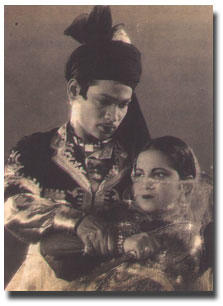
(swordplay part 5)
why were many of the first films ever made in india, hollywood and elsewhere, swashbucklers?
because they were already there : in storytelling traditions and in literature. Swashbucklers were ready to go as soon as there was film, says mathew foster, because the makers didn't have to wait till the mood was right and the techniques were developed. the mood had already been prepared by the original storytellers and the technique had to be only slightly altered to suit film. according to foster, a swashbuckler has three essential elements : movement, a period, and speed. the story moves : from one dramatic scene to another and hence the swings, up and down, in the main character's fortunes. it is set in a period different from ours : 'the morals, heroics, and witticisms are of a different world than ours, and it needs to look that way'. it is fast : the plot doesn't wait to linger and record such subtle details as what's going on in the characters' minds.
the requirements of the crisp recipe outlined above makes the casting director's job easy. what he would obviously look for in a lead actor is energy, and oodles of it. and apart from that, good looks, and not much else. because 'the hero is often less important than the adventures themselves'. is that the reason why popular swashbuckler stars, once stripped of their tights and swords, slip so very fast into oblivion?
one can think of a long list of these suave swordsmen, in all indian and other languages, whose popularity faded faster than the artificial moonlight they serenaded their heroines in, as soon as they attempted to try their hand at more serious cinema. they weren't equipped for it and, quite often, it was too late to start training for it. there were exceptions of course.
jairaj was the first telangani to make a mark in hindi cinema and he did it when it was still in its infancy. and he was one of the first to define the swahbuckler hero in indian cinema. from 'jagmugti jawani' in 1929 to 'hatim tai' almost two decades later, he proved to be an enduring star in this genre. he was able to make a smooth transition from lead roles to character parts only because of the discipline and tenacity he had acquired during his early years as a struggler. many others weren't so lucky.
03/08/05
the unseeing eye

on a mountain pass
i saw this man on an ass
simple he was
simpler his aims -
he wanted
to blow up the buddha's ass.
why, i asked
aghast.
there is no god but god,
he explained,
and we do his little chores
like branding barefaced women whores,
containing music, stopping sports
(and no chin should bear bare spots!)
but why the buddha - a statue rare?
i repeated my question.
like hillary he said, because it's there
an abomination
that's blocking my nation
from true salvation,
and going down on his knees
he prayed to god, please
release
my people
from temptations powerful :
letters are fetters,
culture is a conspiracy,
a woman's every footfall,
echoes the devil's call,
and the infidels all
lurk behind every football,
so saying, he picked up his gun
and fired one
into the sky,
and before god could reply
off rode the man with one eye.
02/08/05
alam era
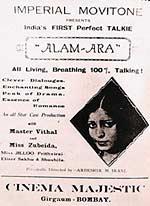 (swordplay part 4).
'Under the category of adventure films, we can include traditional swashbucklers, serialized films, and historical spectacles (similar to the epics film genre), searches or expeditions for lost continents, "jungle" and "desert" epics, treasure hunts and quests, disaster films,and heroic journeys or searches for the unknown. Adventure films are often set in an historical period, and may include adapted stories of historical or literary adventure heroes (Robin Hood, Tarzan, and Zorro for example), kings, battles, rebellion, or piracy.' the pundit again.
that's a comprehensive categorization of the swashbuckler-action-adventure genre of movies made in hollywood in the fairbanks-flynn era. well almost - disaster films were a category which evolved much later, unless you consider 'the last days of pompeii' to be one. which, strictly speaking, it wasn't.
in india, the first talkie 'alam ara' was based on a persian tale, suitably indianised by a veteran parsi theatre-wallah and directed by a parsi, ardeshir irani. the producer, the director, the cast, the crew, the trade, the cinemas, the critics and the audiences- none of them was ready for it. working with the most rudimentary kind of knowledge of sound and its processing, with equally unprepared actors, ardeshir irani had embarked on an adventure as spectacular as the subject of the film he was making. in an era when the producer, director and the lead actor(quite often, one idealist performed all the three functions!) took the prints and the projecting equipment and the crew providing the live musical support and the promotional material, on bullock carts to the audiences in villages and towns, it, probably, didn't seem such a foolhardy enterprise to him. because there were others,equally obsessed, who were undertaking similar ventures in bombay itself, in calcutta, in nasik, in kolhapur, in vizagapatnam, in madras, in mysore and in lahore. looking back, one might conclude that it was sheer good fortune that 'alam ara' hit the screen first. because it was followed by a series of talkies in several indian languages the very same year(1931). and this was just three years after 'the jazz singer', the first hollywood talkie. can we produce that kind of a competitive performance now? in any field? that was the spirit of the era.
what fuelled that widespread drive to pioneer? or, to be more exact, to be the first? ask microsoft. it is the power that every new watershed technology promises the earliest convert. the power to colonise the largest territory, negotiate the best of terms with the trade, capture the widest market, preempt the toughest competition. the power to dominate.
and the pioneers had readymade content, in the form of the vast repository of indian mythology, folklore and legend and literature. it was a time when everyone, whether in the field of cinema or literature or politics or industry, seemed undaunted by the challenges that a hopelessly underdeveloped india posed- they were ready to make the best use of whatever resources they had. and for the cinema folks, the mother lode of indian lore provided the richest source of quality material.
so the swashbucklers and other movies of the 'folk' genre they made had a defined context, a certain recognizable source and an identifiable time-age frame. do the later movies, made after independence, reveal a growing tendency to deny heritage, roots and ideals? specially, the telugu folk movies made in the sixties appear to do so. their indifference to time- isn't that a sure sign of regression? of a people slowly going back to a time of fantasy - when millennia were callously bunched together as vaguely classified 'yugs'? isn't that a sign of denial of the immediate past, specially the eventful battles waged for freedom? of history and of aspirations of redemption and development?
take the taj mahal out of agra and it ceases to tell a story. the filmmakers of the sixties, it would seem, were breaking one of the cardinal rules of storytelling: one that no grandmother ever forgets. to begin every story with a reference to time...long, long ago.
this violation was indicative of the denial of not just the past but, more importantly, the present ( the time the films were made). it was a pointer towards the growing disillusionment in the country, the disappointment with the state and its performance, the slow descent into pessimism & resignation. the lost wars, the famines, the shortages and the queues, the growing corruption and joblessness were taking their toll. india had changed three prime ministers- but the people had very little say in this regard. were they slowly realizing that they were not in charge- just as they weren't all through history?
young india was growing too old, too early.
01/08/05
an odyssey
an odyssey
is a journey
that begins in a hurry
and ends as a story
told and retold
printed and sold
praised and admired
filmed and criticized
as all the while
you grow old
your teeth gold
and your sons pray
that you start
on another odyssey
and this time,
stay away.
sounds neat, right? javed akhtar does too. just as all cleverly packaged nonsense does.
Subscribe to:
Posts (Atom)

 Posts
Posts


